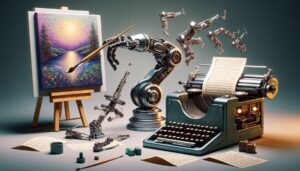
Hey techies! Today, I want to explore a fascinating corner of the AI world that’s packed with potential and creativity: Artificial Intelligence in the creative arts. You heard me right—robots aren’t just here to replace us in the office; they’re coming for our paintbrushes, musical instruments, and quill pens (do people still use those?). If you’ve ever sat through an idle moment wondering when a computer will write the next great novel or craft a number-one hit, then you’re in the right place.
AI and creativity seem like they’d go together as well as oil and water, but trust me, this is a growing field that’s starting to develop some serious flair. With the rise of AI systems like OpenAI’s DALL-E, Google’s DeepDream, and others, we’re seeing an age where machines don’t just replicate human art but redefine it. Let’s explore!
Hits from the (Artificial) Clip
One of the most exciting areas where AI flexes its creative muscles is in the music scene. Algorithms are now capable of composing complex symphonies and catchy pop songs that might make you groove before you even know you’re listening to a silicon composer.
So far, we’ve seen AI-powered platforms like AIVA (Artificial Intelligence Virtual Artist) creating classical music that would make Ludwig van Beethoven nod in approval. I remember stumbling upon one of AIVA’s albums, “Genesis,” on a streaming service out of sheer curiosity. Holding my breath, I pressed play, and what followed was nothing short of remarkable. The music was rich, layered, and full of emotional swells, as human as it was, frankly, electrifying.
Could AI Steal the Show?
But can AI threaten the reign of human composers? Right now, it doesn’t seem like it. AI is more of a powerful collaboration tool that can expand human creativity rather than replace it. Let’s be real—musicians have drawn inspiration from countless sources for centuries, so why not algorithms?
The potential is exciting, and I can’t help but wonder: What if the next global chartbuster is cooked up in a human-machine duet?
Painting Beyond Pixels
Another mind-bending tech trend is the rise of AI in visual arts. DALL-E, a neural network developed by OpenAI, can create images from textual descriptions—yup, you type it, and DALL-E draws it! I have tried to stump this AI by asking it to create a “surreal painting of a cat riding a unicorn on a doughnut-shaped planet,” and you should have seen the feline masterpiece it made. The level of creativity was surprising, going way beyond my initial whimsical idea.
The Essence of Art
Naturally, there are debates (and oh, are they heated) about whether or not this machine-generated art can carry the same emotional weight or meaning as works by human artists. Critics argue that what’s missing is that intangible essence only a human creator can bring. However, supporters see AI art as a new form, introducing us to previously unimaginable visuals and styles, expanding the boundaries of what we’ve traditionally understood as art.
It makes you think about what “creativity” actually is and who—or what—can claim it.
Once Upon a Robotic Story
Alright, let’s move on to storytelling, a cherished human activity and the heart of culture and communication. We all know about GPT-3 (and its successor GPT-4), known for its almost unsettling ability to whip up articles, essays, and (gulp) even blog posts with surprisingly little input.
Story generation is like a wild west for AI, where they’re experimenting wildly and achieving mixed results. Some days, GPT-3’s prose reads like the next Pulitzer prizewinner; other days it sounds like my uncle’s conspiracy theories on Facebook. Yet, the trajectory is clear: AI is a partner in the creative process, offering writers new prompts, plot twists, and even co-authorship.
A New Medium
Could this lead to a new form of literature where interactive AI can customize a narrative for individual readers? It feels like a dream where books read you instead of the other way around. AI isn’t just using words but creating entire worlds; it’s like having an infinite choose-your-own-adventure library.
Why AI Art Matters
Let’s address the elephant-sized paintbrush in the room. Why should it matter that AI can churn out a catchy tune, a mind-bending illustration, or a gripping story? These AI tools can democratize art creation, making it accessible to everyone—not just a select few with years of training. It opens up a world where ideas flow freely between man and machine, allowing us to explore creativity in wild, liberated ways.
Challenges on the Creative Highway
Not all of this is smooth sailing. The emergence of AI in the arts raises a host of challenges, too. Plagiarism is a biggie, with artists fearing entities might feast on their creativity, effectively absorbing a generation of art and repackaging it via algorithmic magic.
There are ethical questions: How do we give credit? Who owns the rights to art created by AI? And should we slap a little “Made by a Bot” label on AI-generated works?
The Road Ahead: Where Are We Going?
Alright, it’s speculation time! Where does this creative AI express train take us? It wouldn’t be far-fetched to imagine a future of mixed media collaborations, where human and AI co-produce full-length movies, albums, and art pieces, blending human inspiration with machine precision.
We’ll see AI evolving from collaborator to celebrator, becoming the DJ of ideas and experiences, remixing them with human hearts. And along the way, we might even learn one or two things from them. Isn’t that a beautiful notion?
Wrapping It Up
So, are we on the brink of a creative renaissance? One led not just by human genius but by silicon savants, too? Well, I think declaring the end of human-created art is a tad too dystopian even for the most pessimistic of us. Instead, the marriage of AI with creative sectors invites joyful experimentation, potentially a golden age for art where creativity has no bounds.
I don’t know about you, but I, for one, am excited to see what the mind and machine can come up with next. To the robots that are painting, composing, and storytelling: welcome to the party! Here’s to a creatively infused future!
What do you think, dear readers? Is AI just a clever collaborator, or is it the Picasso of the future? Let’s chat in the comments!
