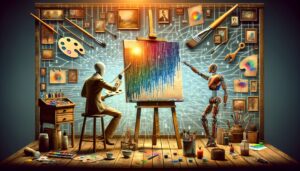
Remember back in the day when AI seemed all about crunching numbers and producing bizarre, mechanical outputs? Fast forward to now, and it’s driving innovation in areas we never imagined, like the creative arts. It’s not just inspiring a new wave of digital Picassos, it’s genuinely breaking down barriers and forging new pathways for human imagination. Join me as we dive head-first into AI’s surprising yet exciting role in the wild world of creativity.
From Computer Code to Creative Companion
Let’s turn back the clock, shall we? I recall the first time I stumbled upon a quirky little AI art generator. You’d provide it with a few keywords, and—voila!—it spat out something reminiscent of a Salvador Dali fever dream. It was fun, but, let’s be honest, not quite reaching for a place in the MoMA. Yet here we are, just a few short years later, and those early playful experiments have grown into a real part of the creative process.
AI’s Colorful Palette
At the cutting edge, AI is not just an assistant but a partner in creation. You’d be hard-pressed these days to find a conversation about modern design or art without AI coming up. Consider music. AI-generated compositions are no longer those quirky, robotic ditties. They’re now finely tuned symphonies that hit our emotions like Beethoven on an electric guitar. OpenAI’s MuseNet, I’m looking at you!
Case in point: Loom.ai has taken storytelling to a new level. It creates fully customized avatars with human-like animation that may soon be appearing live on screens in homes across the world. It’s a fascinating glimpse into how AI is weaving its digital brush over our shared culture.
Challenges: Not All Smooth Canvases
Of course, it wouldn’t be a technology blog post if I didn’t splash a bit of reality into our utopian pigments. Sure, AI in creative domains is nifty and all, but it does come with its own set of hurdles.
The Originality Debate
One of the more heated topics is the originality of AI art. Can we consider art produced by AI as genuinely “original,” or is it merely a reflection of its human creators? There’s a bit of an existential crisis in this. It asks us to redefine how we perceive creativity and challenges our traditional understanding of authorship.
For now, the best approach might be to view AI as a creative collaborative tool rather than a solo artist. Think of it as a ladder helping us see that extra dimension in our creative potential, without stealing the spotlight.
Job Jitters
And then there’s the elephant in the room: job security. Will AI put artists, designers, and musicians out of work? The skeptics among us would pull out a doomsday pie chart here, but I’ve got a more optimistic outlook. AI can’t replicate the human experience—the isolated quietude of an artist’s introspection or the heart-palpitating crescendo of a musician’s impromptu jam session. Creativity is innately human, enhanced but not overpowered by AI’s touch.
Looking Ahead
Now, let’s put on our Nostradamus hat and speculate about the future. Oh, the places AI and the creative arts could go!
A Democratic Canvas
Imagine, if you will, a future where anyone can become an artist. An evolution of platforms like DeepArt and RunwayML might eventually make creativity accessible to the point where that neglected art teacher in everyone’s soul can express themselves without traditional barriers.
It could bring a burst of diversity into the creative field. The emergence of previously unheard (or seen) voices adding their unique flavors to the global creative mix can only enrich our collective culture. AI, in essence, becomes the brush that invites everyone to paint on the world’s canvas.
Bridging Realities
We’re also on the brink of a tighter fusion between digital and physical realities. Through tools like augmented reality and AI, we’ll walk the streets and interact with art installations that adapt in real-time to our moods, interests, or even past experiences.
In this brave new world, our daily environment becomes a changing gallery, curated by AI but deeply personal and entirely unique to each of us. It sounds almost dreamy, right? Yet, it’s not as far off as we might think.
Conclusion: A Brush of Optimism
When folks ask me about AI’s future in the arts, I can’t help but crack a grin. The combination of AI and creativity represents an exciting crossroad in technology and society. While challenges exist, I’m optimistic that the integration of AI in the creative arts will continue to grow, inspire, and empower future generations in remarkable ways.
And who knows? Maybe one day we’ll look back, not in wonder at how computers learnt to create art, but how it amplified what humans always could do. It’s an exciting shift, as long as we keep our hands firmly on the easel. Here’s to a future colored by the hues of both human and silicon creativity. Cheers!
