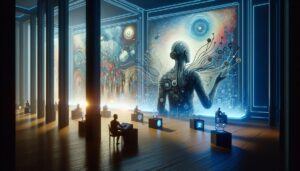
Hey tech aficionados, gather ’round! Today we’re unpacking a topic that’s not just bleeding edge but also heart-racingly exciting: Artificial Intelligence in creative arts. Yep, the very soul of expressive human endeavor is now getting a robotic partner-in-crime. Be it composing a symphony or painting a masterpiece, AI is jumping in—and it’s not dipping its toes, it’s diving right in.
My First Dance with a Robotic Rembrandt
So, here’s how I got hooked. Picture this: I walk into an art exhibit, expecting the usual, only to find out that half the artwork was painted by AI. And I couldn’t even tell which ones! Picture me standing there, a cup of overpriced gallery wine in hand, trying to negotiate my way through a crowd of art critics and hipsters. There was this floral painting that looked like Van Gogh had risen from the grave just to paint it. Turns out it was done by an Artificial Intelligence named DALL-E. Intrigued? Keep reading.
What’s the Canvas Like?
Let’s take a look at what these neural networks are really doing. At the heart of it, something like DALL-E or even its cousin DeepArt gets trained on millions of images. It’s like your typical undergraduate art student who’s binged-watched gazillions of painting tutorials and can now whip up a rendition of “Starry Night” with a touch of rap battle attitude. These algorithms understand and recreate styles, blend concepts, and, in many ways, steer the ship toward places where the human mind, or at least mine, might not naturally go.
Composers and Conductors—The AI Symphony
Now onto the musical stage, where technology and harmony tango in spectacular fashion. Notable mention here goes to OpenAI’s MuseNet which knocked my socks off! This nifty tool can generate 4-minute musical compositions with 10 instruments in a wild mix of styles. You’re telling me it could play “Bohemian Rhapsody” in the style of Mozart? In a word: bananas!
The implications are enormous. We’re talking about democratizing access to music creation. You, sitting in your PJs at 3:00 AM, could compose a symphony worthy of Carnegie Hall. Gone are the days of needing a roomful of expensive instruments just to express your inner Beethoven! You might even craft a genre-bending track that catches the ear of a globetrotting DJ. Imagine the mixtapes AI and humans could drop if they shared the decks.
The Feather in the Cap: AI in Storytelling
Don’t even get me started on storytelling. Text generators like GPT-3 are writing short stories, creating dialogue, and even scripting entire plays. Yes folks, the same engine that suggests your next Netflix fix is now busy writing the screenplays for it too. Bard, Shakespeare’s purported reincarnation in silicon form, has already produced sonnets that are turning literary heads.
However, there are quirks. The AI can whip up an enchanting narrative, yet it might occasionally forget that characters can’t time travel without a DeLorean or suddenly decide they have superpowers. Quirky? Funny? Sure. But those happy little accidents sometimes serendipitously lead to new plot twists that human writers could never have concocted.
Challenges: Not Just a Walk in the Digital Park
Alright, starry-eyed enthusiasts, let’s pump the brakes and talk challenges because it’s not all rainbows and Van Gogh swirls. For one, there’s the ethical conundrum. What counts as authentic art? Are we okay with machines winning prizes meant for humans? And who do we attribute this art to? Is it the programmer, the machine, or some shared entity?
There’s also the risk of these tools reinforcing biases. If AI gets trained on artwork or literature skewed by bias, it could perpetuate those very biases in its creations. It’s a head scratcher, I know; one we’ll need a boatload of ethicists to untangle.
A Peek into the Future Sketchbook
So where do we go from here? Well, I’m holding onto my propeller hat because the whirlwind’s only picking up speed. I think we’re heading toward a future where artists, composers, and writers see AI as a teammate rather than a threat. They’ll collaborate, innovate, and perhaps even redefine what creativity means. Productions that mix human intuition with machine logic may revolutionize how we consume and appreciate content. And maybe, just maybe, a few decades down, AI-driven art will be as celebrated and honored as the human touch it seeks to emulate.
But hey, whether we see this techno-utopian vision as a teammate or a rival, the least we can do is grab some popcorn and enjoy the show. So, what do you think? Dolly Parton reimagined in Picasso’s style, anyone?
As always, I’d love to hear your thoughts and curious musings. What do you think AI’s next big idea in creative arts will be? Drop your sparks of genius in the comments!
Until next time, keep your neural pathways open and your creativity flowing, my tech-savvy pals!
